Last updated on September 11th, 2026 at 06:20 am
Imagine scrolling through your group chat while your friends post photos from a party you weren’t invited to. That sinking feeling of missing out bubbles up inside you. You text “FOMO” and move on—but do you really understand what you just expressed?
In today’s fast-paced, digitally connected world, acronyms like FOMO appear everywhere, from texts to social media posts. Yet, not everyone fully grasps its nuances, or they might use it incorrectly.
This guide breaks down FOMO meaning in text with complete clarity. You’ll discover the definition, different contexts, real-life examples, psychological layers, potential misunderstandings, and expert tips for using it smartly. By the end, you’ll confidently recognize FOMO, know when it applies, and avoid common mistakes—making your digital communication sharper and more precise.
Quick Definition of “FOMO”
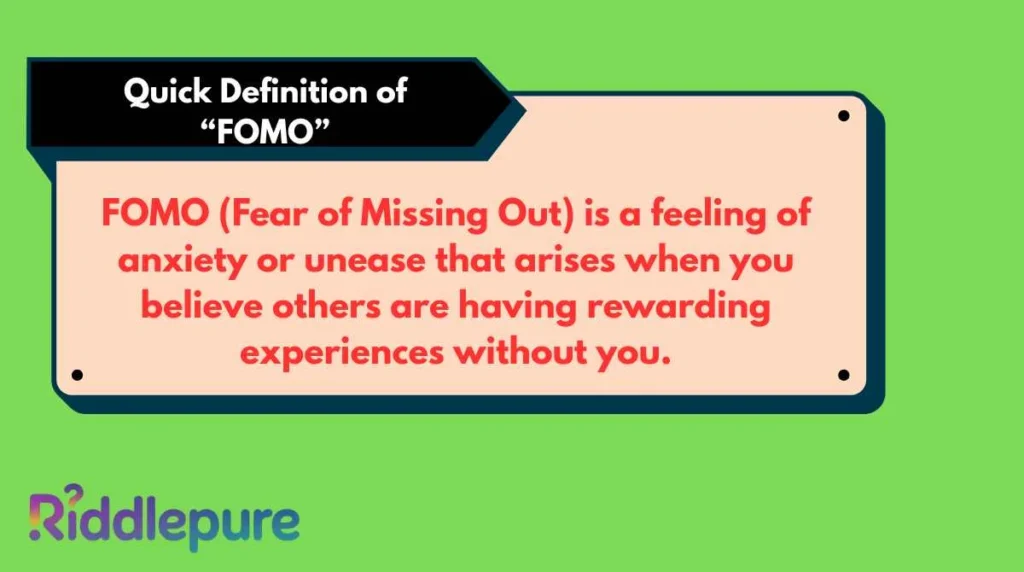
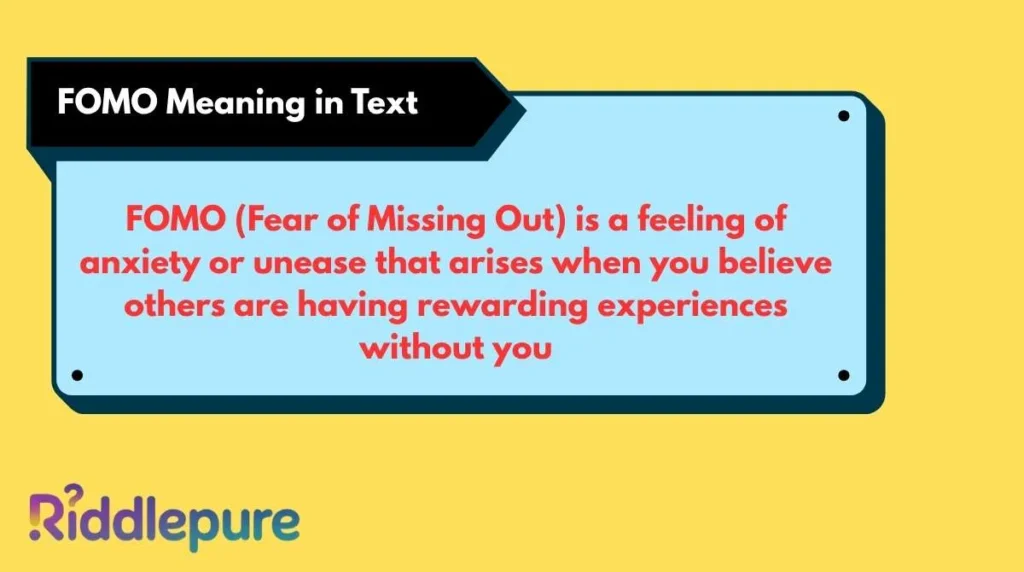
FOMO (Fear of Missing Out) is a feeling of anxiety or unease that arises when you believe others are having rewarding experiences without you. In texts, it signals awareness of social opportunities you’re not part of.
Secondary meanings can include mild envy, social curiosity, or even playful exaggeration of missing events, especially online.
Detailed Meaning Breakdown
Primary Meaning
At its core, FOMO reflects a psychological fear of being left out. Texts using “FOMO” often convey:
- Emotional discomfort: feeling anxious about not joining an activity.
- Social awareness: acknowledgment that others are having a desirable experience.
- Desire for inclusion: seeking to participate or at least be informed.
Example:
“Saw your trip pics… major FOMO here 😩”
Here, the sender expresses a personal longing not to be left out.
Secondary Meanings
- Playful exaggeration – Sometimes “FOMO” is used lightly to indicate casual envy without real distress.
- Marketing context – Advertisements often use “FOMO” to motivate urgency, e.g., “Limited offer! Don’t miss out!”
- Digital culture shorthand – Used to acknowledge trends or viral events in chat.
Rare or Niche Meanings
Occasionally, FOMO may refer to:
- Professional FOMO: fear of missing opportunities in work or networking contexts.
- Event-specific FOMO: short-term anxiety around a single cultural or social occurrence.
What “FOMO” Means in Different Situations
Everyday Texting
In casual conversation, FOMO signals social awareness. Texts are often brief:
- “Can’t make it tonight… total FOMO 😢”
- “All these memes, and I didn’t see them 😭 FOMO!”
It’s a way to communicate regret or playful longing for inclusion without long explanations.
Social Media Platforms
On platforms like Instagram, TikTok, or Twitter:
- Users express FOMO through posts about missing viral trends.
- Emojis often accompany the acronym to amplify emotional tone.
- Hashtags like
#FOMOcreate communal acknowledgment.
Dating & Relationships
FOMO may appear in romantic contexts:
- Fear of missing out on experiences with a partner.
- Anxiety over perceived alternatives (e.g., “Seeing my ex’s pics gives me FOMO”).
- Signals attention and interest, sometimes subtly expressing jealousy.
Professional Communication
While rare in formal messaging, FOMO can emerge in professional circles:
- Networking events: “Can’t attend the conference… FOMO is real.”
- Career updates: recognizing missed opportunities or exclusive workshops.
Caution: use sparingly in professional emails, as it can appear casual or unprofessional.
Cultural or Regional Differences
- Western cultures: Commonly understood in texts and casual conversation.
- Non-Western regions: May require explanation; not all audiences know the term.
- Generational differences: Younger users adopt FOMO faster; older users may prefer full explanations.
Psychological & Tone Analysis
Why People Use It
- Social signaling – Indicates awareness of social happenings.
- Connection seeking – Opens opportunities to join conversations.
- Expressing emotion – Provides shorthand for mild distress or envy.
What It Signals Socially
- Empathy: Recognizing shared experiences.
- Inclusion: Demonstrates desire to participate.
- Trend awareness: Shows engagement with current social or cultural phenomena.
Emotional Layer Behind It
FOMO in text carries subtle emotional undertones:
- Anxiety or regret over missing events
- Curiosity about what others are experiencing
- Desire for shared connection or communal enjoyment
Understanding these layers helps interpret tone beyond literal meaning.
15 Real Conversation Examples (Explained)
- “Saw your concert stories… FOMO 😩”
- Expresses longing to have been at the event.
- “Everyone’s getting the new game. Major FOMO!”
- Highlights desire to join a trend.
- “Missed the brunch again… FOMO strikes”
- Casual regret in daily life.
- “Can’t travel this weekend 😭 FOMO”
- Emotional reaction to social opportunity missed.
- “FOMO hitting hard with all these TikToks”
- Engagement with digital culture.
- “All my friends are at the festival. FOMO central!”
- Exaggerated playful expression.
- “Skipped the webinar… career FOMO”
- Professional context, missed learning opportunity.
- “FOMO on that new restaurant everyone’s talking about”
- Culinary trend awareness.
- “Your vacation pics give me FOMO!”
- Social envy, lightly expressed.
- “Late to the meme train… FOMO forever”
- Digital content consumption anxiety.
- “FOMO is real with this sale 😱”
- Marketing-induced urgency.
- “Can’t believe I’m missing your wedding… FOMO tears”
- Emotional and relational context.
- “Skipped the party… adulting FOMO”
- Humorously combining maturity responsibilities with regret.
- “FOMO kicking in seeing everyone’s Netflix picks”
- Entertainment trends.
- “Virtual FOMO: wish I were there online”
- Acknowledges online-only events or gatherings.
When “FOMO” Can Be Misunderstood
- Context confusion – Some may misinterpret FOMO as general disinterest or sarcasm.
- Generational gap – Older audiences may not immediately recognize the acronym.
- Platform differences – Professional platforms like LinkedIn may view FOMO as too casual or slangy.
- Tone misreading – Without emojis or context, FOMO can seem passive-aggressive or superficial.
Similar Words, Symbols, or Abbreviations
- YOLO – “You Only Live Once,” often used to justify risk-taking.
- JOMO – “Joy of Missing Out,” embracing absence.
- FOMOMO – Fear of missing major opportunities.
- HOMFO – Humorously Overstated Missing Fun Outing.
- LFG – “Let’s F***ing Go,” excitement shorthand.
- BRB – “Be Right Back,” minor temporary absence.
- SMH – “Shaking My Head,” expresses disappointment or disbelief.
- ICYMI – “In Case You Missed It,” highlights information.
- TL;DR – “Too Long; Didn’t Read,” summarizing.
- ICYDK – “In Case You Didn’t Know,” sharing awareness.
When Not to Use “FOMO”
- Professional risks – In formal emails or client interactions, it may appear unserious.
- Cultural risks – In regions where English slang is uncommon, it can confuse audiences.
- Tone risks – Avoid overusing it in sensitive contexts, as it may trivialize emotional responses.
Expert Tips for Using “FOMO” Correctly
- Match tone with audience – Casual with peers; avoid in formal settings.
- Use emojis for clarity – Emojis help convey playful or serious nuance.
- Context matters – Ensure the recipient understands the event or trend referenced.
- Pair with explanation if needed – Especially in multicultural or generationally mixed groups.
- Avoid overuse – Excessive FOMO can seem attention-seeking.
- Leverage for engagement – Use in social media captions to increase interaction.
- Differentiate from professional stakes – Clarify “career FOMO” versus casual events.
- Combine with humor – Lighthearted FOMO expresses emotion without negativity.
Frequently Asked Questions
What does FOMO stand for?
FOMO stands for Fear of Missing Out, describing anxiety about missing rewarding experiences.
Is FOMO only used in texts?
No, FOMO appears in texts, social media, marketing, and casual conversation.
How is FOMO different from JOMO?
JOMO is the Joy of Missing Out, celebrating absence rather than fearing it.
Can FOMO be used professionally?
Yes, but sparingly, and only when the tone is informal or among colleagues familiar with slang.
Why do people experience FOMO?
FOMO arises from social comparison, curiosity, and a desire for inclusion.
Are there emojis associated with FOMO?
Yes, common emojis include 😩, 😭, 😱, and 😔 to signal emotional response.
Can FOMO be positive?
Indirectly, yes—by motivating engagement or encouraging exploration of trends.
Is FOMO universal across cultures?
Not fully—some cultures may not recognize the acronym, requiring explanation.
Final Summary & Smart Usage Advice
FOMO is more than just a text acronym—it reflects emotional, social, and cultural dynamics in modern digital communication. Understanding its primary and secondary meanings, emotional undertones, and context-specific usage allows you to communicate clearly and empathetically.
Use FOMO wisely: in casual chats, playful social media posts, or carefully in professional settings. Recognize when it signals genuine concern, playful envy, or marketing urgency. With the insights from this guide, you can confidently navigate conversations, avoid misunderstandings, and express your experiences in a way that feels both authentic and smart.