In today’s fast-paced digital world, we often encounter abbreviations and shorthand that leave us scratching our heads. One common example is “wut.” You might have seen it in texts from friends, on social media posts, or even in workplace chats.
At first glance, it may seem like a typo, a joke, or something you simply don’t understand. Misinterpreting these shorthand terms can lead to confusion, awkward responses, or even unintended humor.
This guide will demystify “wut” completely. By the end, you’ll understand its meaning, the contexts in which it is used, the emotional tone it conveys, and how to use it safely in your own digital communications.
Whether you’re texting a friend, chatting online, or just curious about modern language trends, this article is your comprehensive resource for “wut meaning in text.”
Quick Definition of “wut”
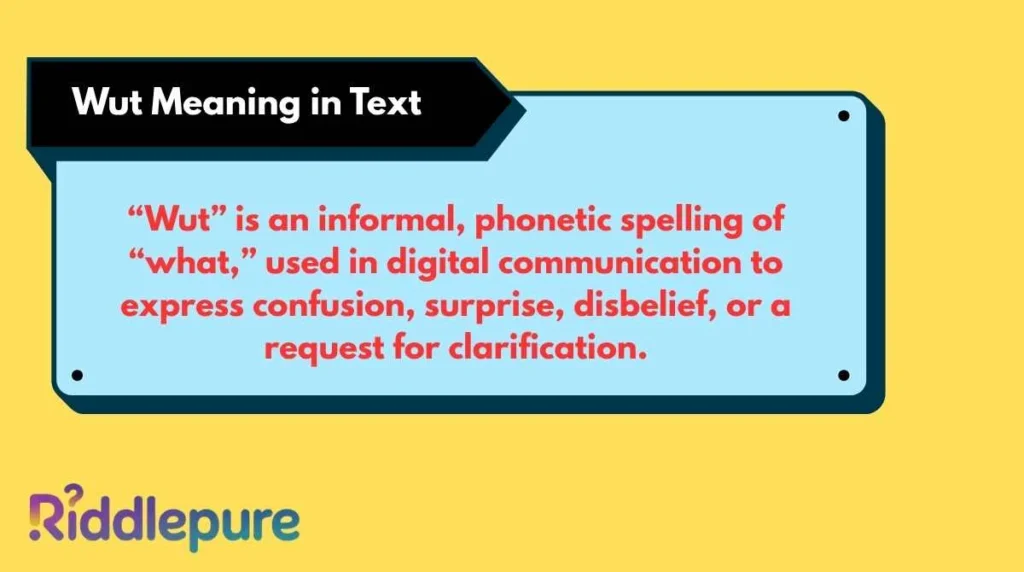
“Wut” is an informal, phonetic spelling of “what,” used in digital communication to express confusion, surprise, disbelief, or a request for clarification.
Secondary meanings can include a humorous or sarcastic tone, depending on context, and sometimes it is used to exaggerate a reaction for comedic effect. While primarily a casual expression, its tone is shaped by the situation and relationship between communicators.
Detailed Meaning Breakdown
Primary Meaning:
At its core, “wut” is simply “what” spelled in a playful or informal way. It signals that the sender did not understand something or is questioning what was just said. Unlike the formal “what,” “wut” often conveys a sense of immediacy, surprise, or casual informality.
Secondary Meanings:
- Humorous or sarcastic: Many users type “wut” to add a comedic or mocking tone to their message.
- Exaggeration of confusion: It can indicate a heightened state of bafflement or disbelief.
Rare or Contextual Meanings:
- Occasionally, “wut” can serve as a meme reference or internet joke, especially when paired with images or GIFs.
- It may also appear in gaming chats to express incredulity after an unexpected event.
What “wut” Means in Different Situations
Everyday Texting
In casual texting between friends, “wut” is commonly used to indicate you didn’t understand a message. For example:
- Friend: “I just saw a dog wearing sunglasses.”
- You: “wut”
Here, it signals mild confusion and curiosity.
Social Media Platforms
On platforms like Twitter, Instagram, or TikTok, “wut” is often paired with humor, memes, or short videos. It amplifies reactions to surprising content and can serve as a quick punchline.
Dating & Relationships
In romantic or dating conversations, “wut” can be playful or teasing:
- Partner: “I may have eaten your fries.”
- You: “wut 😳”
It expresses mock disbelief while keeping the tone light and flirtatious.
Professional Communication
While rare in formal settings, “wut” can appear in informal chats, Slack messages, or quick team discussions. However, using it in emails, reports, or formal presentations is considered unprofessional.
Cultural or Regional Differences
The spelling “wut” is predominantly used in English-speaking online communities. Younger generations are more likely to adopt it casually, while older users or non-native speakers might interpret it as a typo.
Psychological & Tone Analysis
Why People Use “wut”:
- Quick and casual: Easier to type than the formal “what.”
- Adds humor: Softens confusion with playful exaggeration.
- Expresses surprise: Can be used to convey shock or disbelief efficiently.
Social Signals:
- Familiarity: Often signals closeness or casual rapport.
- Shared humor: Indicates awareness of internet culture.
- Light teasing: Can be used to gently mock or exaggerate a situation.
Emotional Layer:
The emotional tone of “wut” is context-dependent: it may express genuine confusion, playful sarcasm, or exaggerated surprise, often relying on accompanying punctuation, emojis, or GIFs.
15 Real Conversation Examples (Explained)
- Friend: “I adopted a pet dragon.”
You: “wut 😲”
Explanation: Expresses disbelief with playful exaggeration. - Colleague: “We need the report by yesterday.”
You: “wut?”
Explanation: Signals confusion about an impossible deadline. - Sibling: “I replaced your toothpaste with wasabi.”
You: “wut 😂”
Explanation: Combines confusion with humor. - Group Chat: “I can bench 300 lbs now.”
You: “wut??”
Explanation: Shows astonishment and requests clarification. - Text: “Aliens are real.”
You: “wut”
Explanation: Simple disbelief without judgment. - Online Forum: “The game glitched and I fell through the map.”
You: “wut 🤯”
Explanation: Indicates surprise and amazement. - Romantic Partner: “I baked cookies but forgot sugar.”
You: “wut 😬”
Explanation: Light teasing and mild disbelief. - Friend: “I joined a secret ninja clan.”
You: “wut???”
Explanation: Playful sarcasm in response to absurdity. - Text: “I met your doppelgänger today.”
You: “wut 😳”
Explanation: Shock and curiosity combined. - Social Media Comment: “I just ran a marathon backwards.”
You: “wut 😂”
Explanation: Humor and disbelief at an exaggerated claim. - Colleague Chat: “We are merging the departments.”
You: “wut? Already?”
Explanation: Confusion and urgency about unexpected news. - Message: “I won the lottery but gave it away.”
You: “wut??”
Explanation: Surprise and request for clarification. - Friend: “I dyed my hair rainbow.”
You: “wut 😆”
Explanation: Fun and playful reaction. - Gaming Chat: “I just got a legendary drop!”
You: “wut?! Congrats!”
Explanation: Excitement and acknowledgment of achievement. - Text: “I adopted a pet tarantula.”
You: “wut 🕷️”
Explanation: Surprise mixed with mild apprehension.
When “wut” Can Be Misunderstood
- Context Confusion: Without tone or emoji cues, “wut” may seem rude or dismissive.
- Generational Gap: Older users may see it as unprofessional or sloppy spelling.
- Platform Differences: On professional networks like LinkedIn, it may be interpreted as careless or informal.
Similar Words, Symbols, or Abbreviations
- wat – Another informal spelling of “what.”
- huh – Expresses confusion or a request for clarification.
- lol wut – Combines humor with confusion.
- what the heck – Slightly stronger form of disbelief.
- omg wut – Expresses shock or surprise.
- wtf – Stronger, more vulgar form of disbelief.
- eh? – Common in casual British English for “what?”
- pardon? – Polite request for repetition or clarification.
- say what – Informal American slang for “what?”
- ? – Single-question mark can serve the same function in texting.
When Not to Use “wut”
- Professional Risks: Using it in emails, formal reports, or workplace memos can appear unprofessional.
- Cultural Risks: In certain cultures, casual or playful shorthand may be interpreted as disrespectful.
- Tone Risks: Without context, it may come off as rude or dismissive.
Expert Tips for Using “wut” Correctly
- Pair with emojis for clarity.
- Reserve for informal conversations.
- Avoid in professional or academic messages.
- Use multiple question marks only for exaggeration.
- Match tone to context: playful, sarcastic, or curious.
- Be aware of generational differences in understanding.
- Combine with humor to soften confusion.
- Observe platform norms: some communities embrace “wut” more than others.
Frequently Asked Questions
What does “wut” mean in texting?
Answer: “Wut” is an informal spelling of “what,” used to express confusion, surprise, or disbelief.
Is “wut” rude?
Answer: Not inherently, but it can seem dismissive if used without context or emojis.
Can I use “wut” professionally?
Answer: Generally no; it is best reserved for casual or informal settings.
What’s the difference between “wut” and “what”?
Answer: “Wut” is playful, informal, and often humorous, while “what” is standard English.
Is “wut” only used online?
Answer: Mostly yes, in texting, social media, and online chats.
How do I know when to use “wut”?
Answer: Use it when you want to convey casual confusion, surprise, or humor.
Are there alternatives to “wut”?
Answer: Yes, including “huh,” “wat,” “say what,” and “what the heck.”
Does “wut” have a tone?
Answer: Yes, it can be playful, sarcastic, surprised, or exaggerated depending on context.
Final Summary & Smart Usage Advice
“Wut” is a small word with big expressive power. It allows you to convey confusion, disbelief, or humor efficiently in casual communication. Its tone and impact depend on context, emojis, and your relationship with the recipient.
Use it thoughtfully, avoid professional or formal settings, and pair it with visual cues when possible. With this guide, you can confidently interpret and use “wut,” keeping your digital conversations clear, fun, and expressive.