You’re scrolling through your group chat, and suddenly someone types “STFU”. Your heart skips a beat. Are they angry? Is it a joke? Or did you just misread the mood?
Text abbreviations like this one can be confusing, especially when tone is missing. In today’s digital communication, acronyms and slang are everywhere, and understanding them can save awkward moments—or even social faux pas.
“STFU” is more than just a random string of letters. It has evolved from online forums to texting, social media, and even casual spoken language in some circles. Yet, many people—especially across different generations—still stumble when interpreting it.
This guide breaks down the meaning, usage, tone, and subtle variations of STFU, giving you everything you need to understand and use it correctly in 2026.
Quick Definition of “STFU”
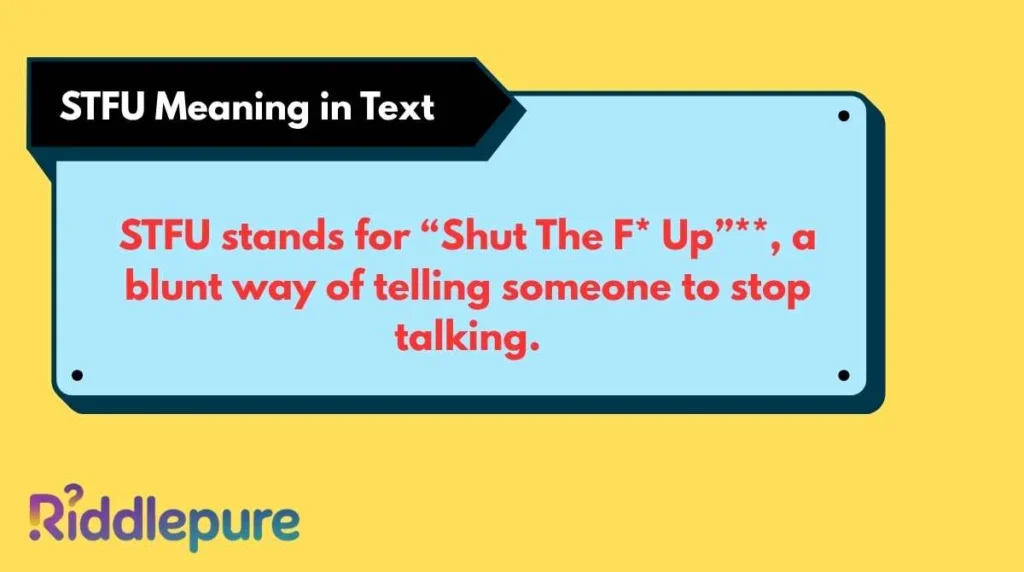
STFU stands for “Shut The F* Up”**, a blunt way of telling someone to stop talking.
- Primary meaning: Stop speaking immediately, often with a rude or humorous tone.
- Secondary meanings: Can be used jokingly among friends, sarcastically online, or as an expression of disbelief or frustration.
Detailed Meaning Breakdown
Primary Meaning
The primary meaning of STFU is direct and often harsh: telling someone to be quiet. In text form, it carries the same intensity as saying it aloud, but context and tone can soften or amplify its impact.
- Example: “STFU, you’re overthinking it!” → Here, it may be playful, depending on the relationship between the texters.
Secondary Meanings
Over time, STFU has developed subtler uses:
- Joking or teasing friends: Often used in a humorous or ironic way.
- Expressing disbelief or surprise: Like saying “No way!” or “You’re joking!”
- Exaggerated reaction: Online memes or social media comments often use STFU to dramatize shock or excitement.
Rare Meanings
Some niche online communities or gaming circles have slightly different interpretations:
- “Stop Talking, Fully Understand” – rare, humorous backronym.
- “Silence The Fun Users” – playful, specific to certain forums.
What “STFU” Means in Different Situations
Everyday Texting
In casual messaging apps, STFU is usually informal and depends on tone. Among friends, it’s often playful, sarcastic, or part of banter. However, with strangers, it can come across as offensive.
- Example: “STFU, I can’t believe you did that!” → likely joking if sent to a close friend.
Social Media Platforms
On platforms like Twitter, Instagram, and TikTok, STFU is commonly used in reactions, comments, or captions to express:
- Surprise
- Disbelief
- Exasperation
Memes often amplify the humorous use, making it less harsh than in personal messages.
Dating & Relationships
Using STFU with a partner can be tricky. Among playful couples, it can be teasing. In early dating, it may seem rude or dismissive. Context is everything.
- Example: “STFU, I love that!” → playful exaggeration.
- Example: “STFU, stop texting me.” → serious and dismissive.
Professional Communication
Generally, STFU is inappropriate in professional settings. Using it with coworkers or supervisors can damage credibility. In rare cases, it might appear in informal team chats among close colleagues, but caution is essential.
Cultural or Regional Differences
- In North America, STFU is widely recognized and often humorous among younger generations.
- In some European countries, it may not be understood at all, or the explicit language can be considered offensive.
- Tone sensitivity varies: English-speaking cultures are generally more tolerant in casual contexts.
Psychological & Tone Analysis
Why People Use It
- Efficiency: Shortens a strong sentiment into four letters.
- Emotional release: Expresses frustration, disbelief, or humor quickly.
- Social signaling: Demonstrates familiarity, sarcasm, or camaraderie.
What It Signals Socially
- Power or dominance: Can assert authority in a joking or serious way.
- Humor and closeness: Among friends, it signals comfort and playful teasing.
- Disapproval or irritation: Depending on context, it can express annoyance or boundary-setting.
Emotional Layer Behind It
- Surprise: “STFU, no way!”
- Anger: “STFU, that’s ridiculous!”
- Affectionate teasing: “STFU, you’re so dramatic!”
The emotional tone depends heavily on punctuation, emojis, and relationship dynamics.
15 Real Conversation Examples (Explained)
- Friend chat:
- Text: “STFU, I won the game!”
- Explanation: Playful excitement among friends.
- Sibling banter:
- Text: “STFU, you ate my snack?”
- Explanation: Mild teasing; not serious anger.
- Online meme comment:
- Text: “STFU, this is hilarious 😂”
- Explanation: Expressing laughter and surprise.
- Dating text:
- Text: “STFU, you’re too cute 😘”
- Explanation: Flirty and playful.
- Gaming chat:
- Text: “STFU, stop camping!”
- Explanation: Frustration in competitive gaming.
- Reaction to shocking news:
- Text: “STFU, that’s unbelievable!”
- Explanation: Expressing surprise, not anger.
- Group chat exaggeration:
- Text: “STFU, we have 5 more hours?! 😱”
- Explanation: Dramatic reaction; humorous context.
- Joking with coworker:
- Text: “STFU, you finished early?”
- Explanation: Informal humor among close colleagues.
- Annoyed text to friend:
- Text: “STFU, stop spamming the chat.”
- Explanation: Mild irritation, still informal.
- Social media reply:
- Text: “STFU, this is trending already!”
- Explanation: Highlighting surprise or urgency.
- Sarcastic reaction:
- Text: “STFU, like that will ever happen.”
- Explanation: Sarcasm in casual conversation.
- Teasing a sibling:
- Text: “STFU, you can’t beat me at Mario Kart.”
- Explanation: Playful rivalry, humorous tone.
- Online debate:
- Text: “STFU, facts don’t care about opinions.”
- Explanation: Assertive, slightly aggressive stance.
- Friend exaggeration:
- Text: “STFU, that was the worst movie ever!”
- Explanation: Dramatic humor rather than true offense.
- Shock reaction:
- Text: “STFU! You got tickets for free?!”
- Explanation: Expressing excitement and disbelief.
When “STFU” Can Be Misunderstood
Context Confusion
Without tone or facial cues, STFU may seem aggressive even if intended as a joke.
Generational Gap
Older users may interpret STFU literally and take offense. Younger users often see it as humorous or casual.
Platform Differences
On LinkedIn or email, it’s inappropriate. On Discord, TikTok, or private texting, it may be playful.
Similar Words, Symbols, or Abbreviations
- LOL – Laughing out loud.
- OMG – Oh my God.
- SMH – Shaking my head.
- WTF – What the f***.
- GTFO – Get the f*** out.
- LMAO – Laughing my ass off.
- IDK – I don’t know.
- BRB – Be right back.
- YOLO – You only live once.
- FML – F*** my life.
These abbreviations often coexist in the same digital conversations.
When Not to Use “STFU”
- Professional risks: Can damage credibility in emails, Slack messages, or meetings.
- Cultural risks: May offend audiences unfamiliar with slang or sensitive to strong language.
- Tone risks: Misinterpreted as aggression instead of humor.
Expert Tips for Using “STFU” Correctly
- Know your audience: Only use with friends or informal groups.
- Check context: Avoid using it in sensitive situations.
- Use emojis wisely: 😂, 😘, or 😱 soften the tone.
- Avoid professional chats: Stick to casual platforms.
- Understand timing: Reactions work best immediately after surprising or funny events.
- Combine with humor: Pair with jokes or exaggeration.
- Avoid strangers: Misinterpretation risk is high.
- Read the room: Consider the emotional state of others before sending.
Frequently Asked Questions
What does STFU mean in text messages?
STFU stands for “Shut The F* Up”** and is usually a blunt way of telling someone to stop talking, often jokingly among friends.
Is STFU rude?
It can be rude if used seriously but can also be playful, sarcastic, or humorous depending on context.
Can STFU be used in professional settings?
No. It is highly informal and inappropriate for most professional communication.
Is STFU understood globally?
Mostly in English-speaking countries, but tone sensitivity varies, and some cultures may find it offensive.
Can STFU be used flirtatiously?
Yes. Among close partners, it can be teasing or playful.
What’s the difference between STFU and GTFO?
STFU tells someone to stop talking, while GTFO means “Get the F* Out”** and usually refers to leaving a space or situation.
Are there safe alternatives to STFU?
Yes. You can use “please be quiet”, “hush”, or humorous emojis to convey the same sentiment politely.
Why do people use STFU online?
It’s quick, expressive, and signals humor, surprise, or frustration without lengthy explanations.
Final Summary & Smart Usage Advice
STFU is a powerful, versatile text abbreviation that can communicate humor, frustration, surprise, or sarcasm in digital conversations. Its meaning depends heavily on context, tone, and audience.
Use it confidently with friends or in informal spaces, but avoid professional or culturally sensitive situations. Pair it with emojis or humor to soften tone, and always consider generational and platform differences.
Mastering STFU usage allows you to engage in online conversations with clarity, wit, and appropriate social awareness.